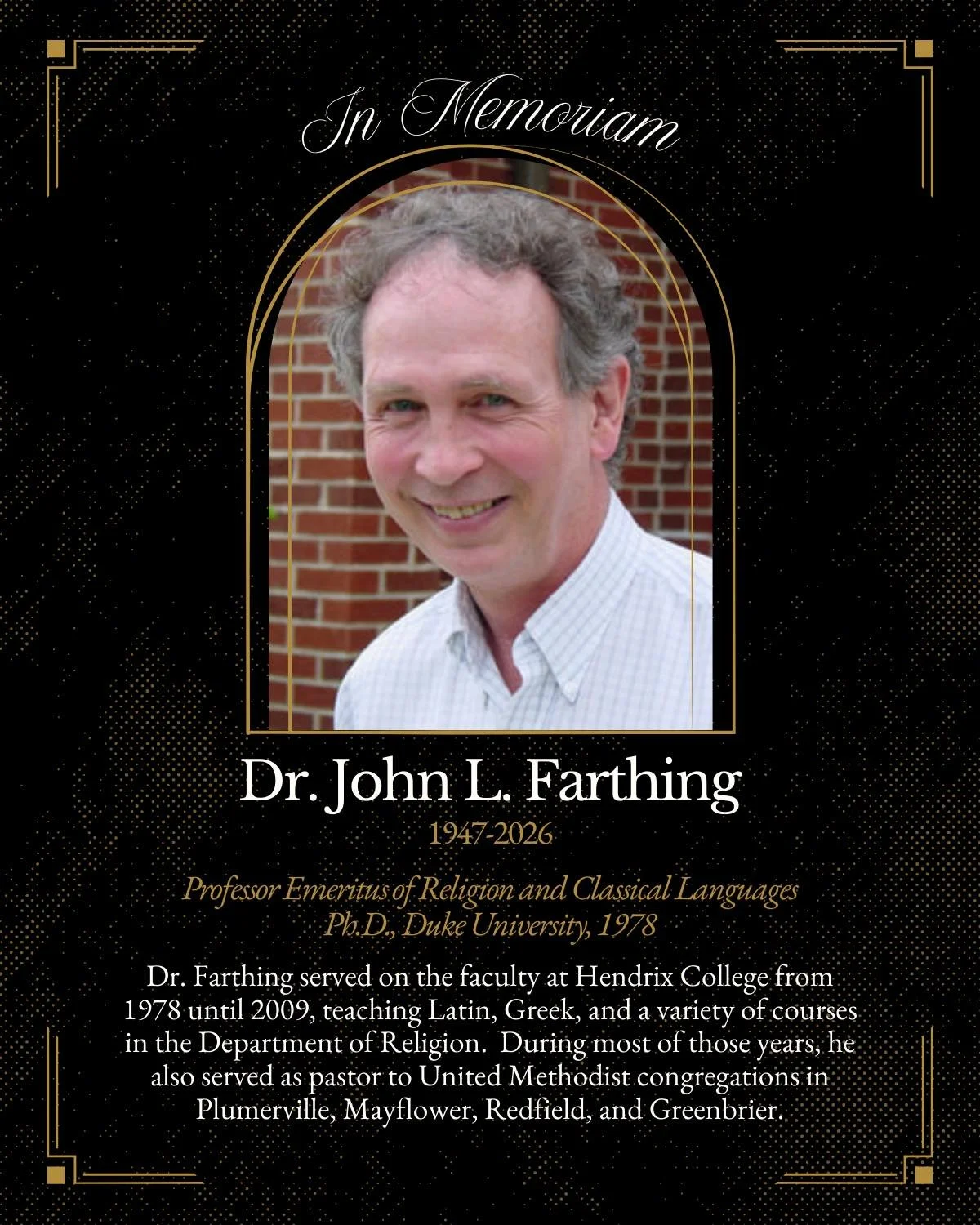
The Rev. Dr. John L. Farthing
(1947-2026)
“The Hendrix community is saddened by the passing of Dr. John Farthing on January 8, 2026. Dr. Farthing served as Professor of Religion and Classical Languages at Hendrix College from 1978 to 2009.
He received degrees from the University of Tulsa as well as Duke University (Master of Divinity and PhD). Students often visited the many United Methodist churches he served while teaching full-time, including Redfield, Plumberville, Mayflower, and Greenbrier.”
Dr. John Farthing Memorial Service
In preparing his final arrrangments, Dr. John Farthing wrote: “I hope that any memorial service will be an emphatic thanksgiving for God's immense goodness to me, a proclamation of the Gospel that I have preached, and an affirmation of the faith that I proclaimed for forty years as a United Methodist elder, I hope that the service will be a joyful celebration of the faith in which I lived and died.”
Norma and Rebekah asked me to preach about John’s faith. I was honored to share these words in fulfillment of his wishes at his memorial service at Greene Chapel at Hendrix on January 31, 2026.
Memorial Sermon for Dr John Farthing
The Golden Thread of Grace
Rev Blake Bradford
January 31, 2026
Greene Chapel, Hendrix College
Matthew 18:1-5
At that time the disciples came to Jesus and asked, “Who is the greatest in the kingdom of heaven?” He called a child, whom he put among them, and said, “Truly I tell you, unless you change and become like children, you will never enter the kingdom of heaven. Whoever becomes humble like this child is the greatest in the kingdom of heaven. Whoever welcomes one such child in my name welcomes me.
The Rev Dr John Farthing was a rich tapestry of a man who lived his faith with compassion, love, and grace, and he lived it with generosity and with a deep spirit of invitation. Each of you gathered here today encountered John through a different thread of that tapestry, and each of you experienced holy moments alongside him, moments of delight when something more was happening than you could fully explain. Norma and John’s family have asked me to speak of John’s faith - the faith he preached for 40 years and lived out for 78.
When John talked about his own theological background, he often described the conservative context in which he was raised: - I remember his words, “We didn’t handle snakes, but we were a little envious of those who did.” That line always got a laugh, but it also revealed something deeper about John, because even then he was already holding together seriousness and playfulness and curiosity .. faith and conviction tempered by openness and wonder.
John never lost his wonder…He brought an almost unrestrained, childlike sense of awe, accompanied by and incredible depth of compassion and a keen and disciplined mind that could mine the depths of the Christian faith and its long tradition.That combination of curiosity and conviction, wonder and discipline, shaped the way John saw the world and the way he spoke and preached and taught about God.Somewhere along the way, John glimpsed the intersection of our moment in time and God’s eternity of grace, and once he saw it, he invited you along
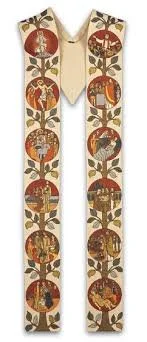
I think of a tapestry, like this clerical stole tapestry (this one is titled “History of the church “- very apropos), where every once in a while you notice a gold thread that seems to poke out from nowhere, sprinkled like a bit of glitter catching the light. But those of you who sew know better, because if we were to open this tapestry up and look beneath the surface, we would see a vast maze of gold thread. It runs underneath the whole design of the tapestry, unbroken, holding the pattern together. John experienced Grace like that, as the gold thread interwoven throughout the whole tapestry of creation. For John, faith was not primarily about mastering doctrine, but about receiving grace. John could teach Aristotelian vs Platonic realism through the writings of Thomas Aquinas or Augustine, and they might quibble with my metaphor. But John, for all the research and learning and teaching about the heights and depths of Christian theology over the generations, (learning that sank into the bones of many in this chapel,) for all the creeds and catechisms, John’s passion, his wonder and awe, could also be as childlike as the children on Jesus’ knee in Matthew 18.
And that is why he taught and preached about babies being asleep at their baptisms. John preached that Grace is present not because it is earned, (we can’t do it by ourselves) It’s not really about intellectual assent and certainly not because those children are religion majors with an A+ in theology.
John taught that we don’t really have to understand Grace, but Grace certainly understands us. Grace that meets us before we understand it, A Trust in God that holds us whether we are awake or asleep, doubting or questioning, certain or uncertain. It is not nothing that the hymn John specifically asked to be included in this service “My Faith Has Found a Resting Place”, has its first verse:
♫My faith has found a resting place,
not in device or creed;
I trust the ever-living One,
his wounds for me shall plead.♫
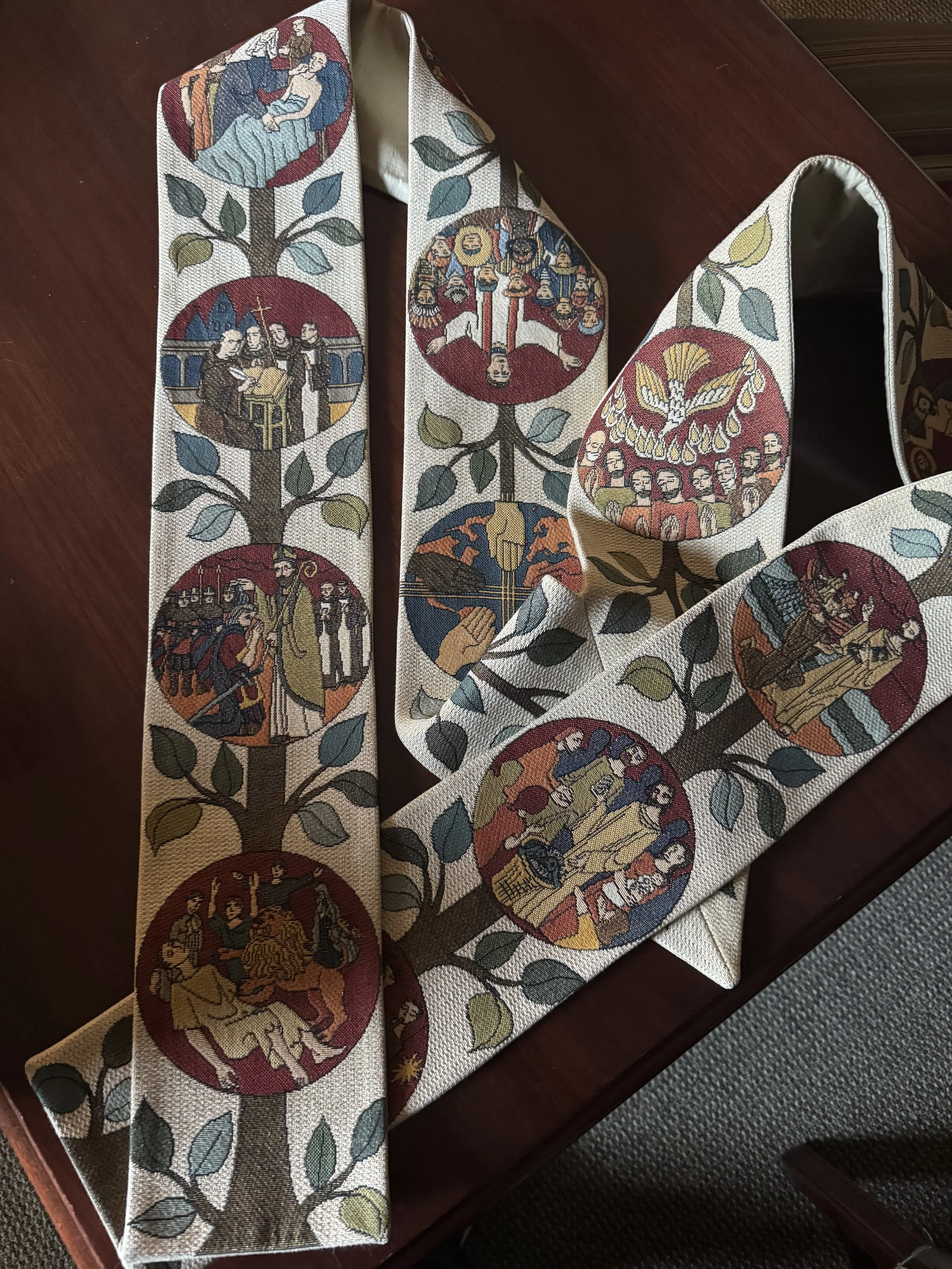
I truly believe that John Farthing saw, more than most, the gold threads of grace woven through our collective lives. ..the divine reality beneath the visible one, the love under the life, and the grace under the grit. These gold threads of Grace were: the source of his compassion, the through-line of his sermons, and the foundation of his relationships. Every once in a while, he would tug on a gold thread. I can almost picture John plucking on it, exclaim in joy at what he had found, and then invite you to see it too, not to impress you, but to invite you into awe and wonder, grace and gratitude. For many of us, his passion and encouragement seemed to stop time, creating singular and unrepeatable holy moments of grace upon grace upon grace…. moments of delight when John encouraged you, …pushed you to think deeply, ….joined you, ..and made you feel seen and valued… perhaps even loved. John lived that wonder out through his relationships with us, and through the many callings God entrusted to him:
As a United Methodist Elder, appointed to parish churches for 40 years, he married and buried, preached sermons week after week. John was also sent, more than once, into difficult church situations that required hard truth, faithful courage, and .. (what I called it during my Cabinet Term)… “holy encouragement”, and along the way, he experienced awe and wonder that then sent him back into ministry again and again.
As a prophet, sometimes a holy rabble-rouser, John marched for civil rights.. John stood with the poor, with immigrants, and with prisoners on death row, taking seriously the red-letter words of Jesus in Matthew 25, words that were radical in the truest sense of the word, (That’s radical from the latin radix, to the root - I worked hard to get that “C” in Latin 3). John the Radical - the Prophet -certainly got to the root of things!.
As a professor, John was a teacher and mentor to countless lay and clergy leaders throughout Arkansas and beyond, a careful and disciplined researcher and educator, and a world-class scholar of the second-generation, sixteenth-century Protestant reformer Jerome Zanchi. John was drawn to Zanchi because of his theological rigor. But I take note that Zanchi, this man from half a millennia ago, whom John spent decades researching was himself a professor, a pastor, and a family man who spent His life serving refugees and exiles. Soul after soul, generation after generation of students, John had a way of seeing the best in people before they could see it in themselves. When he spoke with you, he made you feel valued and understood and beloved. Many alumni look back on his classes as their favorite and most memorable, not simply because of the content, but because of the way John taught. If you took a class in the Raney Building, you can probably still hear that booming voice echoing through the rooms. I can picture walking into his office through a labyrinth of book stacks, arranged like a game of Jenga. I can still see him in that (let’s lovingly call it “vintage”) powder-blue suit, dusted with chalk. And when you sat with him, he leaned in close, encouraged you, drew something new out of you (new thoughts, new perspectives). John’s affection for you was never dependent on agreement with him, because he invited conversation, curiosity, and the freedom to think while trusting grace at the same time. Time had a way of stopping in those moments, and, for so many of us in this chapel today, they became holy moments, whether you realized it at the time or not.
But, of course, John’s life was never confined to classrooms and pulpits.
John was also a husband, a brother, a friend, a father, and a Poppy to Landon and Layton. Rebekah shared with me last week how John absolutely adored being Poppy, joining in the boys’ antics with childlike wonder and amusement, (and – Rebekah, …. -> after hearing a few of your stories, I am honestly not sure whether it was the boys or “Poppy” who needed more adult supervision.) Running alongside that gold thread, through every role and relationship, was John’s truest identity and calling as a disciple of Jesus Christ and a grateful recipient of grace, an identity that shaped his teaching, his relationships, and his life.
Norma, as I said to you last week, from the moment John met you, he lapsed into poetry, because prose was never enough. From that first blind date for coffee to your wedding right here in Greene Chapel, and day after day after day, holy moment after holy moment, from town and ministry to retirement on the lakeshore… Norma, you and John kept writing the poem together.
In preparation for today, as I sat with Norma, Rebekah, and Lance, it came up that John and Rebekah’s had taken a devotional journey through the medieval mystics (he never stopped teaching), and, sitting in the living room, they quoted words of Julian of Norwich, writing 700 years ago, speaking of death and resurrection and heaven:
“All shall be well, and all shall be well, and all manner of thing shall be well.”
I remember learning those words years ago over in the Raney Building, and today, in this sacred moment, with you, John’s family and the greater circle of friends, these words ring deeper and truer than ever. … “All will be well, and all shall be well, ….” …..Well done, good and faithful servant.
And now, for those of us who remain, my prayer is simple: May those of us blessed enough to glimpse even a bit of that gold thread alongside John be renewed in our vocation. Vocation comes from the Latin vocare, which means to call, (And John taught us to love words like that because words matter and connect us to our humanity and to God. - see john’s sermon “God and the L-Word”) So may we hear again God’s vocation - God’s call- in our own lives: to be professors or pastors, prophets or friends, spouses or Poppys, perhaps disciples of Jesus Christ, ..and all of us beloved children of grace. May we carry John’s generous spirit of invitation into our own lives and relationships, and may we learn, as he did, to pull reality back (just enough) to notice the gold threads of grace and to invite others into the awe, the wonder, and the love of God. Peace be with you. Thanks be to God.
Dr. John Farthing (1947-2026) was a beloved disciple and servant of Jesus. He exuded grace, kindness, generosity, curiosity, and (most of all) love. I am blessed to count myself as one of his students, colleagues and friends. His ministry touched countless lives, and he shaped an incredible number of our clergy through the decades.
John Farthing shaped my soul, my vocation, and my faith. He was an instrument of God’s grace in my life, and I cannot imagine my life separate from his impact.
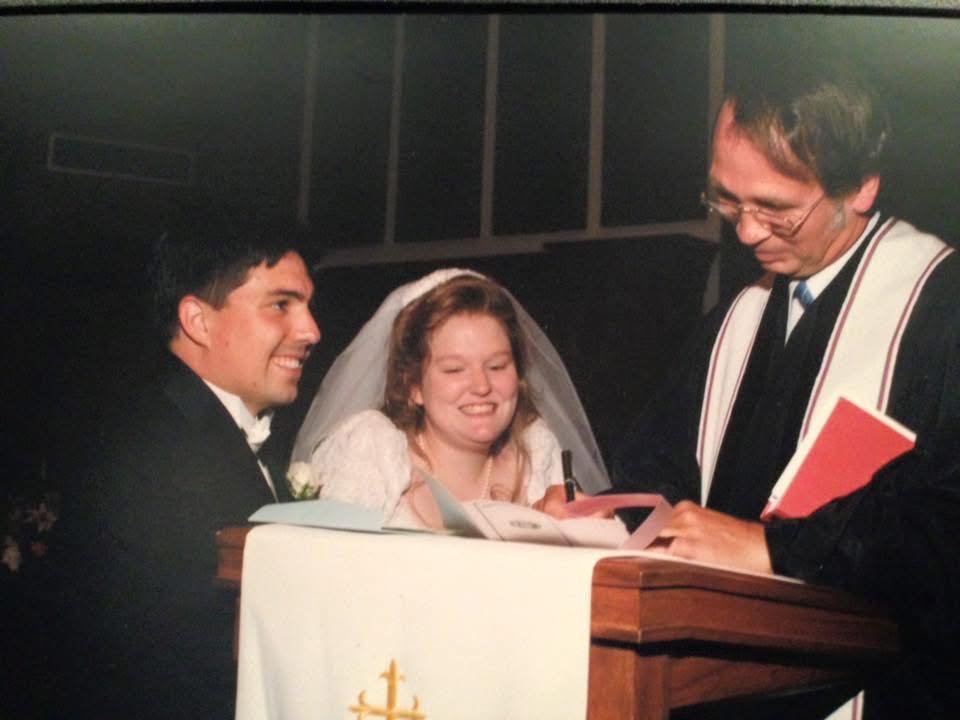
He led me to Christ, performed our wedding, baptized our daughter, and was instrumental in my call story- I was actually rooming with him at an academic conference in Atlanta when I was a grad student, and he was the one who helped me process my call to ministry just minutes after the experience there. It was an honor to be a groomsman at his wedding to his beloved Norma.
And, of course, course, like generations of students, disciples, and so many clergy, Dr Farthing taught me about God, history, and the church. He attempted to teach me Greek and Latin as well, but some endeavors were impossible even for John.
In 2008, a number of us were asked to write letters of memories and love, as part of a surprise celebration for John. I can only imagine that the book overflowed with stories, blessings, and the abundant calling of God through this incomparable man. Here are a couple of excerpts from my letter:
“In my first term in 1992, I took your class studying the History of Christianity and discovered this fellow named Augustine and his beliefs on the Trinity. You hooked me then. When you told me as a freshman to join your junior-level class on Methodism, you said, “come on in, the water is fine.” Yes it was! That class became my confirmation class as I was baptized later that fall. For the next several years, your teachings profoundly shaped my identity and my belief in God. Latin classes taught me how to write, and theology classes taught me how to think.”….
….“As I think back, I see your presence there at many of the turning points of my life: my claiming of Christ, the spark of my academic interest, my love for the Eucharist, my call to ministry (at a 16th Century Studies Conference, no less!), my marriage to Kerri, and the baptism of our treasured Gabrielle. My memories are filled with blessings, and you stand there, presiding over these moments as over the Table of the Lord.”
John, I will remember you always, and rejoice with you in glory. Well done, good and faithful servant.